Your AVIF vs WebP Questions, Answered With Actual Test Data
Is AVIF actually smaller than WebP?
Usually, yes, but the size of the gap depends entirely on the image. Large, detailed photographs are where AVIF's advantage shows up clearest: industry testing puts it at roughly 20 to 30% smaller than WebP at matched visual quality, with some benchmarks reporting up to 50% on complex photographic content. That's the number most comparison articles quote, and it's accurate for that kind of file.
Why did my own AVIF conversion barely shrink at all?
Because not every file is a large detailed photograph. We ran a real test through our converter: a 36.36 KB WebP file converted to AVIF and came back at 36.17 KB, a drop of just 1%.
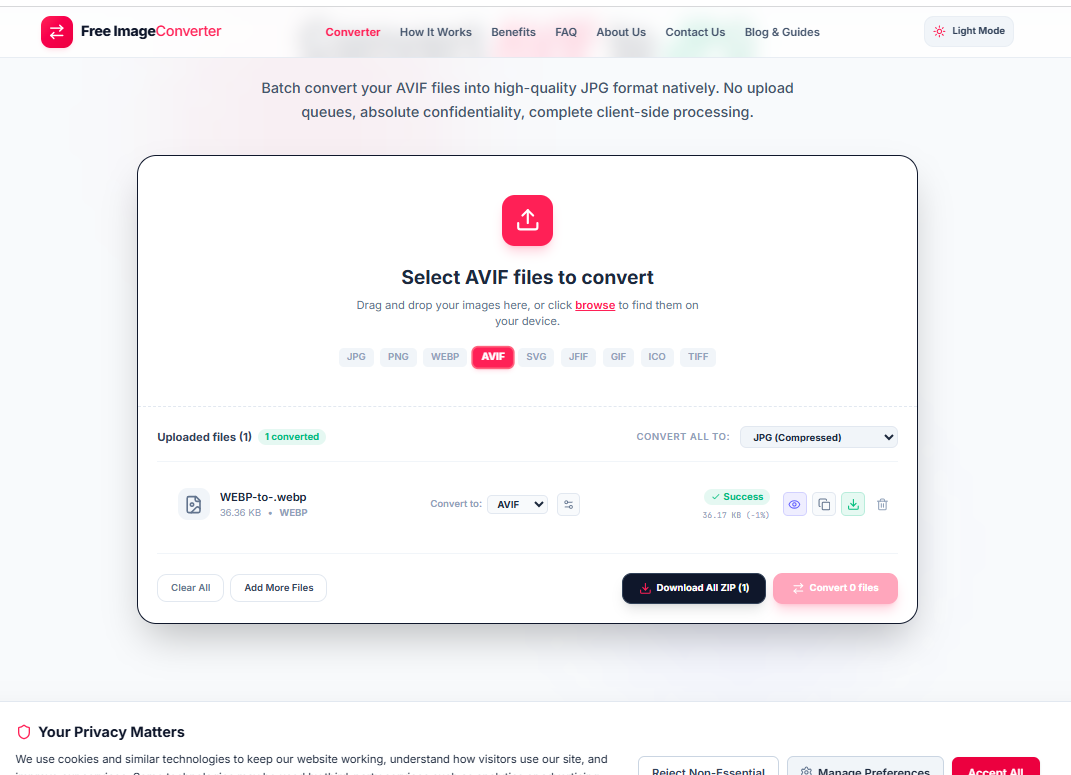
That's nowhere near the 20-50% headline number, and the reason is simple. WebP had already compressed most of the redundant data out of that file before AVIF ever touched it. When a source file is already small and simple, there isn't much left for a second, more efficient codec to squeeze out. The dramatic percentages you see quoted online come from testing on files with a lot more visual complexity to work with.
Does that mean converting backward, from AVIF to WebP, loses ground too?
Not necessarily, we tested this direction as well. That same file, now a 36.17 KB AVIF, converted back to WebP at 33.95 KB, a 6% drop.
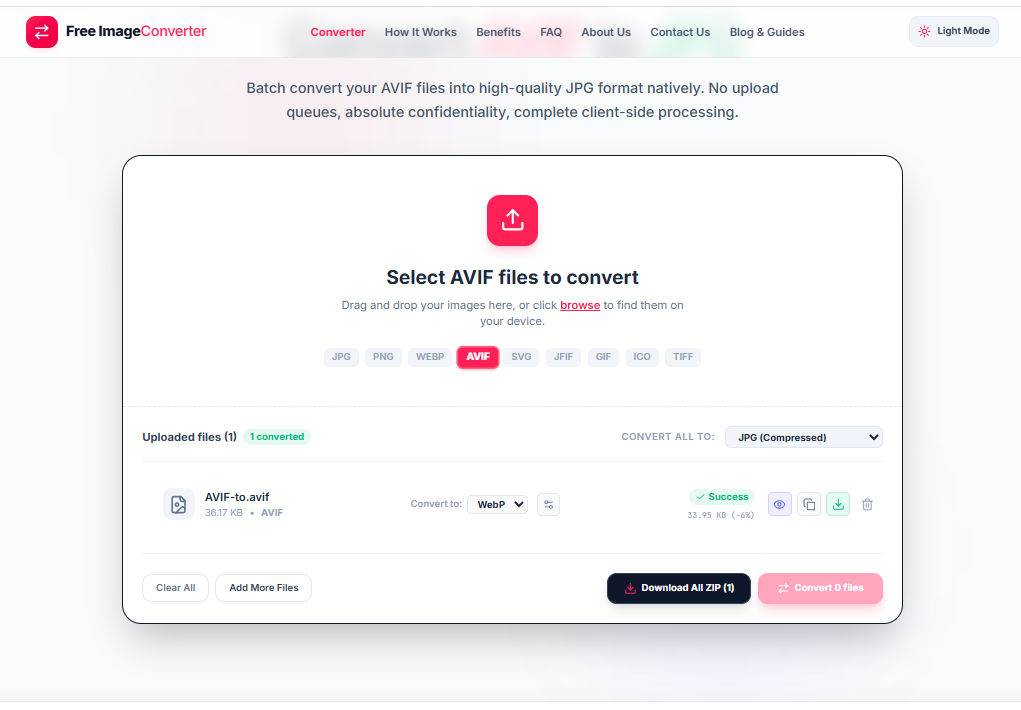
Converting in either direction on this particular file landed both formats within a few percent of each other. Neither result is "wrong," it just shows why quoting a single universal percentage for AVIF vs WebP is misleading without knowing what kind of image you're actually converting.
Is AVIF slower to convert than WebP?
Yes, and by a wide margin. AVIF's compression is built on the AV1 video codec's prediction system, which requires significantly more processing than WebP's simpler prediction modes. Published benchmarks put AVIF encoding at roughly 5 to 10 times slower than WebP for equivalent quality settings. We noticed this in our own testing too: the AVIF conversion visibly took longer to finish than the WebP conversion of the same file, even though the file itself was small. On a batch of dozens or hundreds of images, that gap adds up fast if you're converting on demand rather than once ahead of time.
Will an AVIF file open everywhere a WebP file does?
Not quite yet, though the gap has narrowed a lot. As of 2026, WebP has roughly 97% global browser coverage, essentially universal at this point. AVIF sits around 93 to 95%, with the remaining gap concentrated in older Android browsers and outdated Safari versions still in circulation. For software outside the browser, the difference is bigger: older versions of Photoshop, some print workflows, and a number of upload forms and CMS platforms handle WebP without issue but still reject or mishandle AVIF files. We didn't personally hit an AVIF compatibility problem while testing, our own converter handled both formats cleanly, but that's specific to this one tool, not a guarantee for every piece of software you might use downstream.
Does AVIF actually look better, or is it just smaller?
Depends what you're comparing on. At matched file size, AVIF tends to hold detail and avoid compression artifacts slightly better than WebP, particularly as compression gets more aggressive. But the bigger structural difference is color range: WebP is capped at 8-bit sRGB, the same limit JPEG has. AVIF supports 10-bit and 12-bit color depth along with HDR and wide color gamut. If your images are headed for standard web display, this won't matter much. If you're building anything aimed at HDR-capable screens, photography portfolios, or color-critical work, it's a real advantage WebP has no way to close.
So which one should I actually use?
For general web images where you want the safest, most universally compatible modern format with fast, cheap encoding, WebP is still the sound default in 2026. For large photographic assets, hero banners, or product photography where you're encoding once and serving the file many times over, AVIF's extra compression is usually worth the slower one-time conversion. Plenty of sites now serve both, AVIF to browsers that support it, WebP as the fallback, which covers nearly everyone without picking one format over the other.
Given how much the actual gap varies by image, as our own numbers show, it's worth testing your specific files in both directions rather than assuming a percentage you read somewhere will hold. Our converter supports both formats along with eight others from the same upload, so checking is a two-minute job.
Ready to benchmark AVIF and WebP?
Convert your assets between modern AVIF and WebP codecs with local, fast in-browser encoding.